Rare Book Monthly
Articles - February - 2010 Issue
To Reuse or Not to Reuse, That is the Question
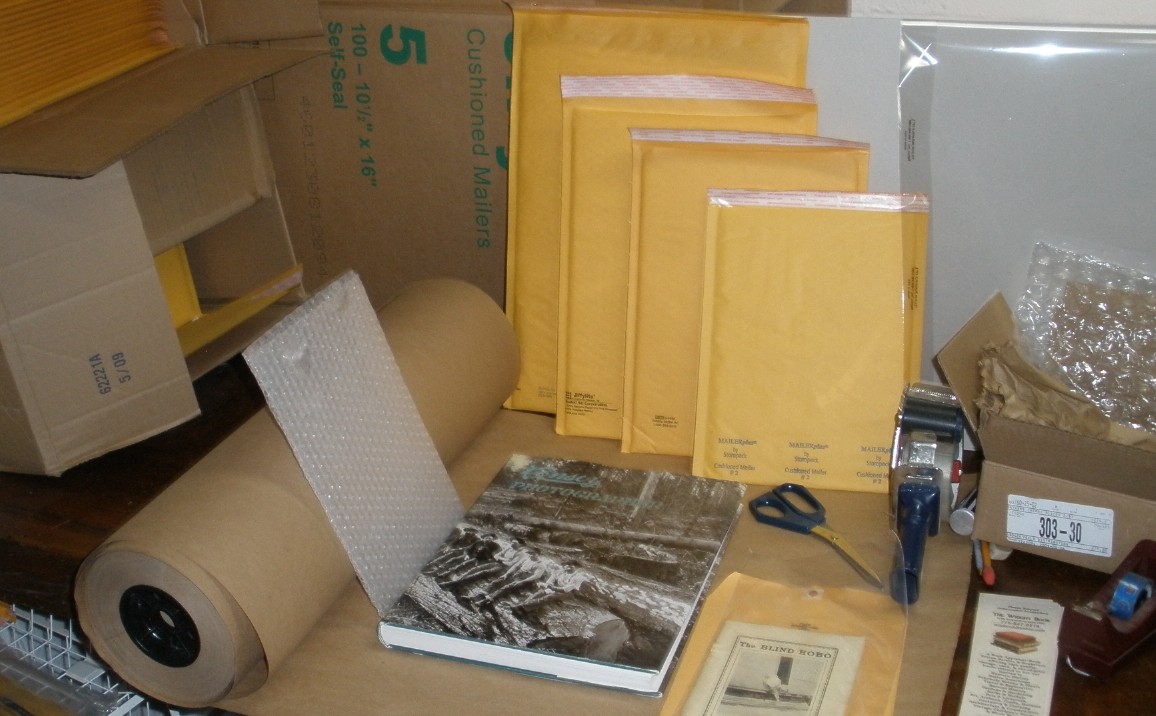
Packing can include both new and old material.
By Karen Wright
Wow! When I put a call out to two different booksellers' organizations, IOBA and my ABS group, asking for comments and opinions about wrapping books in new or reused materials, I didn't know I was about to be barraged with a hurricane of replies. But, thanks very much to all of you who did reply, you helped get this article off the ground and though I couldn't use all the info you sent, I've tried to paraphrase and condense so you can see what the other folks are up to without falling asleep halfway through this tome.
What really started me thinking about reusing packaging material was when I got an updated notice from the former fearless leader of IOBA, Shawn Purcell, with this good advice about shipping: "State your rates clearly, don't make shipping a profit center, process the order quickly, include a professional receipt, use good butcher paper and bubble wrap, a box is almost always better than a mailer, become familiar with all the shipping options and protections, and send it out quickly."
One does not need to be a "fanatic environmentalist, it's just good sense" as one bookseller put it. It certainly makes sense to me to reuse and recycle. It costs less, it is good for the world, which is burying itself in trash, and frankly, I don't think that, except for the snootiest of collectors, anyone really gives a mule's tail whether or not the package is pretty as long as their books arrive in a timely manner, well packaged, and without dents and broken spines. But that's just me.
The packing materials I use are sometimes new, but more often reused materials that I collect hither and yon; i.e. boxes that have packets of cheese in them are almost always the size of one or two 8vos or 4tos, so I hit up the gal at the grocery store and she kindly does not slice the top off with her deadly box cutter, but opens them so they can be reused. Also, I live in a tourist town and there are lots of gift shops, bars, and antique stores. They often reuse their bubble wrap, but if not they know to call me and I'll come running. You know the adage - their trash, my treasure.
I only use clean stuff with minimal-to-no tape, and no odd odors or soiling. I often find big rolls of clear packing tape at flea markets, but be careful, they may be old and cracked or too thin and fragile to use so check them before you buy. I do buy bubble envelopes in various sizes for low range 8vos and small 4tos, but anything bigger goes in a box. Almost every book is wrapped in brown butcher paper, then either bagged or boxed, depending on the weight of the book, its fragility, its value, and how far it has to go. So far I have, in twenty years, only had one book returned damaged, and that was by a post office person who set it on something so sharp and so hard that it pierced a bubble wrapper and two layers of brown paper, the hardback cover, and about thirty pages of text. They must have been practicing sword-fighting tricks in the back room and stabbed it with a rapier, for heaven's sake! Oh, and I insure anything over $50.00, just in case. Many booksellers recommend getting delivery confirmation. I don't always; again it depends on where it is going and the price of the book.
So, anyway, that's how I do things, but what about other folks?
I started with one of the big boys. I live near the Alibris warehouse in Nevada. They're not usually too happy to see an email from me. But I emailed Peter Skerritt at Alibris Client Services with a question. I've toured their huge facility. They have dozens of folks opening envelops and boxes and I wanted to know why they couldn't open the package, make sure that it is the correct book in the proper condition, and then slap their label on it and reseal it instead of tossing thousands of boxes, bubble wrappers and other materials in the recycle bins.
He said he spoke to one of the shipping people and they explained that "…although the packaging material that we discard after opening those packages is recycled, we do not use the same package to re-send the order on to the customer. There are several reasons for this, and it starts with the opening process. This can be a furiously fast process when there are six cages of packages, each containing several thousand packages and everything has to be opened, inspected, then placed in the line to be checked in as "received". I've seen as many as fifteen cages in a day, so there's no time to be too gentle with a package when opening it. They're careful not to damage the contents, but the packaging is not an important item. And the packaging that we use is completely different than the material that most sellers use and our own label and logo is affixed to our packages shipping from the Distribution Center. It's all standardized there."
![<b>Sotheby’s, Dec. 11:</b> Darwin and Wallace. On the Tendency of Species to form Varieties..., [in:] <i>Journal of the Proceedings of the Linnean Society,</i> Vol. III, No. 9., 1858, Darwin announces the theory of natural selection. £100,000 to £150,000.](https://ae-files.s3.amazonaws.com/AdvertisementPhotos/00d5fd41-2542-4a80-b119-4886d4b9925f.png "<b>Sotheby’s, Dec. 11:</b> Darwin and Wallace. On the Tendency of Species to form Varieties..., [in:] <i>Journal of the Proceedings of the Linnean Society,</i> Vol. III, No. 9., 1858, Darwin announces the theory of natural selection. £100,000 to £150,000.")