Rare Book Monthly
Book Catalogue Reviews - June - 2006 Issue
Rare and Unique Books and Manuscripts from the 19th Century Shop

Catalogue 111 from the 19th Century Shop.
By Michael Stillman
Just released is catalogue number 111 from the 19th Century Shop. Their specialty is "rare books and manuscripts of all ages." "Rare" is certainly the word for the 19th Century Shop's material, as it is all either very rare books and related material, or one-of-a-kind manuscripts and ephemera, survivors that have somehow overcome the odds to make it intact to the 21st century. It should also be noted that this is not a catalogue of the obscure, but significant and important material for those who collect on a high level. Here are a few examples.
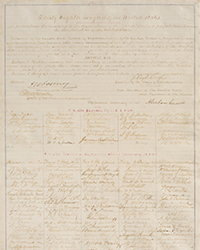
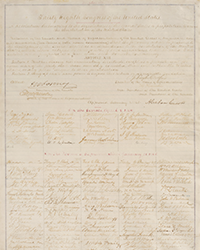
In 1863, the United States Treasury Department promulgated a set of regulations to deal with one of those issues no one particularly liked to recognize - trade between the Union and the states in rebellion. Naturally, no one wanted to help, or seem to help, the other side, and yet a certain amount of commercial intercourse was necessary for both sides, despite the deadly war taking place between them. Those regulations were published in a compendium headed "Commercial Intercourse with and in States Declared in Insurrection, and the Collection of Abandoned and Captured Property," dated September 11, 1863. On February 21, 1865, Treasury Agent Hanson A. Risley sent a letter, on "Commercial Intercourse with and in States Declared in Insurrection" stationary, to the President notifying him of increases in a government contract to purchase cotton from "insurrectionary states." That increase was from 15,000 to 50,000 bales, roughly one-sixth of the Confederate states' cotton production for 1864. The embargo on southern cotton had caused problems for both sides, southern planters and northern manufacturers, had led to much speculation, and raised a risk that European states might intervene in America's Civil War to obtain cotton. This contract represented a necessary commercial accommodation between parties otherwise engaged in mortal combat. Offered is Agent Risley's request, which is approved and autographed by the President, with the notation "Approved A. Lincoln Feb 24 1865." Priced at $32,000.
Their reputations would head in different directions in the years ahead, but here is a dinner menu from August 13, 1969, containing the signatures of four famous Americans. Three are from the Apollo 11 astronauts, first man on the moon Neil Armstrong, Lunar Module Pilot Buzz Aldrin, and Command Module Pilot Michael Collins. The other signer, whose reputation did not remain at quite the high level of esteem as the astronauts, was President Richard Nixon. As to why they were all signing a dinner menu, the Apollo mission had only returned to Earth a few weeks earlier, and after the astronauts spent 18 days in quarantine, the President evidently felt that it would be nice to treat them to a good meal. Nixon did have his soft side. $25,000.