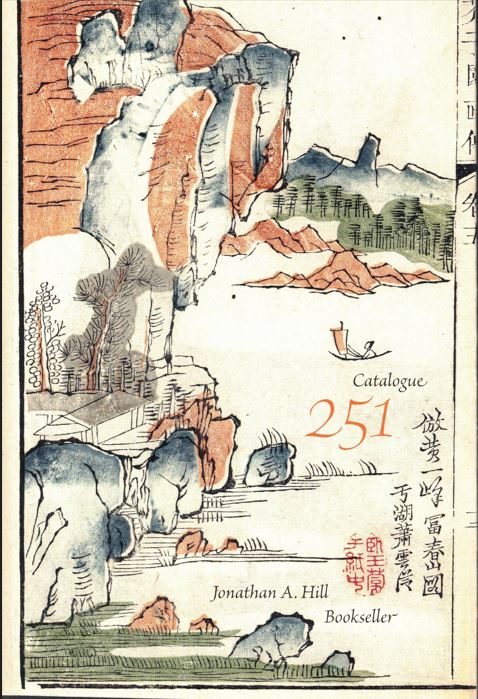
Jonathan A. Hill Bookseller recently issued a new catalogue, Catalogue 251 Asian Books, Manuscripts, & Scrolls: China, Mongolia, Tibet, Taiwan, Korea, Japan, & Vietnam. These are old books and manuscripts, mostly from the 16th century to the 19th. Titles are generally given in phonetic versions of non-English words but translations are provided too. Items are well-illustrated, many with 6-12 full-page illustrations. Color images are provided where there is color. Many are pre-color printing or are manuscripts, though a few of these as well as some earlier books had added hand-coloring.
Eastern culture is certainly very different from Western. For Americans, this is nothing like looking at European culture. Still, much of what people want is universal, peace, health, long-life, caring for families. Ultimately, we are all human. Here are a few selections.
Li Shizhen has been described as "probably the greatest naturalist in Chinese history." It is impressive if no one has yet surpassed him since he lived in the 16th century. He is undoubtedly the "greatest historian of science before modern times." He was particularly familiar with medicine and pharmacology, being a physician himself. Scientific knowledge in 16th century China was scattered through numerous writings passed down from the ages. Li Shizhen took on the task of putting it all together, adding to it from his own experiences, and correcting some errors (not all because scientific knowledge in the 16th century was greatly wanting by today's standards). Li also organized the data he found and put it into logical classifications. Darwin cited this more than any other Chinese book and was influenced by the Li's classifications. Li wrote many books, but this one is his masterpiece, on which he dedicated much of his life, Bencao Gangmu (systematic materia medica). He recognized his book's lasting importance and was proud of what he accomplished. Unfortunately, it was not that well recognized by authorities and consequently was not published during his lifetime. Li died in 1593, 15 years after he completed the work. It was left to his family to publish it, which they did in 1596. Offered is an early edition, published in 1717, generously illustrated. Item 16. Priced at $15,000.
This sort of medical book is a good example of rationalism gone awry. Zhao Xianke had a theory about the kidneys, as explained in a six-volume first Japanese edition from 1661 (first edition from China was published ca 1617). Medical knowledge in 1617 was not that good, and dissection was not allowed so even scientists had to speculate. Zhao's speculation made sense, in a sense, for the era. He believed that an internal fire determined health, too weak, or too intense could cause illness, even death. The kidneys were associated with water, and water controlled the intensity of the fire. As such, he determined that the kidneys were the gate of life. It all made sense, though it had little to do with reality. The book's title (translated) is One Principle Through Medicine. Zhao never developed much of a following, even in his long-ago lifetime, and his ideas were soon discarded. Item 73. $7,500.
This is a manuscript account of a journey to America from Japan. It wasn't an ordinary visit. It is a well-known story in American-Japanese relations that Commodore Perry visited Japan seeking to have that country open its doors to trade. The Japanese refused, which led to Perry's ultimate imposition of gunboat diplomacy, using America's superior navel power to force Japan to open its doors to trade. In 1854, Japan acquiesced. An official treaty was agreed to in 1858, and in 1860, a the first Japanese embassy to America arrived on the nation's shore. The Japanese brought with them an official letter of ratification from the shogun to present to President Buchanan. Once the official duties were concluded, the Japanese began a tour of American cities, Baltimore, Philadelphia, and New York. The visitors were welcomed with parades, receptions, dance balls, and tours. It was the first Japanese official visit to a western nation. Having been forced into a relationship, the Americans sought to win the Japanese over to friendlier relations. The Europeans were also looking to reach their hearts and America wanted to retain the upper hand. This journal recounts the visit and provides the Japanese impressions of the western world. Item 64. $7,500.
This is a book about smoking in Japan, Mesamashigusa (the wakeful weed), by Seichutei Shukushin. Its take on smoking is very different from what it would be today, but this book was published in 1815 when no one knew any better. On top of that, the author was a tobacco merchant which would have influenced his point of view. Hill notes that tobacco arrived in Japan around 1570 and by 1820, almost everyone in Tokyo was using it. The book places smoking in its historical context and recounts its history in Japan. It purports to be transcribed from a scholarly book for the benefit of women and children. Seichutei discusses the medical benefits of tobacco, including using smoke as an enema. Don't try this at home. Item 57. $4,950.
This scroll comes from the late Edo Period in Japan, approximately mid-19th century. In America, it was a time of enormous change, the horrors of slavery finally coming to an end. In Japan, there were even more monumental changes, as American naval forces forced the long isolated country to finally open up to the world. Much as they fought it, like the American South, they needed it. This scroll shows how bad some things can become when a society stays hidden from the light of human progress for centuries. The scroll contains color images of punishments for crimes. Japan obviously had no Eighth Amendment prohibition against cruel and unusual punishment. What's depicted is torture, and the most gruesome and awful imaginable. What makes it even more horrific is that punishment for crimes was not permitted without confession. What was permitted was the use of torture to get "confessions." Naturally, if the suspect confessed, they did not escape horrible punishment. The punishments after confession were equally brutal. It begins with policemen using spears, followed by a woman roped into submission while separated from her young daughter. Next, suspects are put in chains and a cangue (a heavy wooden board placed on the shoulders while the head protrudes through a narrow hole). There are beatings, clothed and unclothed, with a heavy rope. Then in court, judges try to elicit confessions. If unsuccessful, the tortures get more gruesome, heavy granite blocks placed on the suspect, tying up in twisted, painful positions, hoisted up by the arms and suspended. Then it displays punishments for those "convicted," beatings while tied in painful positions, and for those given capital punishment, decapitation, severed heads on display, burning to death and crucifixion. Women prisoners are common and treated no better. Item 68. $6,500.
Jonathan A. Hill Bookseller may be reached at 917-294-2678 or jonathan@jonathanahill.com. Their website is www.jonathanahill.com.
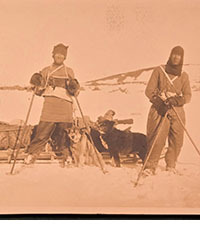
![<b>Scandinavian Art & Rare Books Auctions, Dec. 4:</b> ROALD AMUNDSEN: «Sydpolen» [ The South Pole] 1912. First edition in jackets and publisher's slip case.](https://ae-files.s3.amazonaws.com/AdvertisementPhotos/0a99416d-9c0f-4fa3-afdd-7532ca8a2b2c.jpg "<b>Scandinavian Art & Rare Books Auctions, Dec. 4:</b> ROALD AMUNDSEN: «Sydpolen» [ The South Pole] 1912. First edition in jackets and publisher's slip case.")
![<b>Scandinavian Art & Rare Books Auctions, Dec. 4:</b> AMUNDSEN & NANSEN: «Fram over Polhavet» [Farthest North] 1897. AMUNDSEN's COPY!](https://ae-files.s3.amazonaws.com/AdvertisementPhotos/a077b4a5-0477-4c47-9847-0158cf045843.jpg "<b>Scandinavian Art & Rare Books Auctions, Dec. 4:</b> AMUNDSEN & NANSEN: «Fram over Polhavet» [Farthest North] 1897. AMUNDSEN's COPY!")
![<b>Scandinavian Art & Rare Books Auctions, Dec. 4:</b> ERNEST SHACKLETON [ed.]: «Aurora Australis» 1908. First edition. The NORWAY COPY.](https://ae-files.s3.amazonaws.com/AdvertisementPhotos/6363a735-e622-4d0a-852e-07cef58eccbe.jpg "<b>Scandinavian Art & Rare Books Auctions, Dec. 4:</b> ERNEST SHACKLETON [ed.]: «Aurora Australis» 1908. First edition. The NORWAY COPY.")
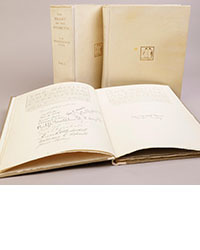
![<b>Scandinavian Art & Rare Books Auctions, Dec. 4:</b> SHACKLETON, BERNACCHI, CHERRY-GARRARD [ed.]: «The South Polar Times» I-III, 1902-1911.](https://ae-files.s3.amazonaws.com/AdvertisementPhotos/3ee16d5b-a2ec-4c03-aeb6-aa3fcfec3a5e.jpg "<b>Scandinavian Art & Rare Books Auctions, Dec. 4:</b> SHACKLETON, BERNACCHI, CHERRY-GARRARD [ed.]: «The South Polar Times» I-III, 1902-1911.")
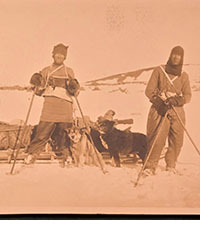
![<b>Scandinavian Art & Rare Books Auctions, Dec. 4:</b> [WILLEM BARENTSZ & HENRY HUDSON] - SAEGHMAN: «Verhael van de vier eerste schip-vaerden […]», 1663.](https://ae-files.s3.amazonaws.com/AdvertisementPhotos/d5f50485-7faa-423f-af0c-803b964dd2ba.jpg "<b>Scandinavian Art & Rare Books Auctions, Dec. 4:</b> [WILLEM BARENTSZ & HENRY HUDSON] - SAEGHMAN: «Verhael van de vier eerste schip-vaerden […]», 1663.")
![<b>Scandinavian Art & Rare Books Auctions, Dec. 4:</b> TERRA NOVA EXPEDITION | LIEUTENANT HENRY ROBERTSON BOWERS: «At the South Pole.», Gelatin Silver Print. [10¾ x 15in. (27.2 x 38.1cm.) ].](https://ae-files.s3.amazonaws.com/AdvertisementPhotos/fb024365-7d7a-4510-9859-9d26b5c266cf.jpg "<b>Scandinavian Art & Rare Books Auctions, Dec. 4:</b> TERRA NOVA EXPEDITION | LIEUTENANT HENRY ROBERTSON BOWERS: «At the South Pole.», Gelatin Silver Print. [10¾ x 15in. (27.2 x 38.1cm.) ].")
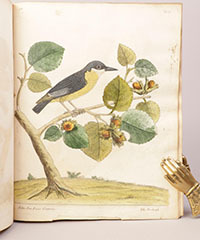
![<b>Scandinavian Art & Rare Books Auctions, Dec. 4:</b> PAUL GAIMARD: «Voyage de la Commision scientific du Nord, en Scandinavie, […]», c. 1842-46. ONLY HAND COLOURED COPY KNOWN WITH TWO ORIGINAL PAINTINGS BY BIARD.](https://ae-files.s3.amazonaws.com/AdvertisementPhotos/a7c0eda0-9d8b-43ac-a504-58923308d5a4.jpg "<b>Scandinavian Art & Rare Books Auctions, Dec. 4:</b> PAUL GAIMARD: «Voyage de la Commision scientific du Nord, en Scandinavie, […]», c. 1842-46. ONLY HAND COLOURED COPY KNOWN WITH TWO ORIGINAL PAINTINGS BY BIARD.")
![<b>Sotheby’s, Dec. 11:</b> Darwin and Wallace. On the Tendency of Species to form Varieties..., [in:] <i>Journal of the Proceedings of the Linnean Society,</i> Vol. III, No. 9., 1858, Darwin announces the theory of natural selection. £100,000 to £150,000.](https://ae-files.s3.amazonaws.com/AdvertisementPhotos/00d5fd41-2542-4a80-b119-4886d4b9925f.png "<b>Sotheby’s, Dec. 11:</b> Darwin and Wallace. On the Tendency of Species to form Varieties..., [in:] <i>Journal of the Proceedings of the Linnean Society,</i> Vol. III, No. 9., 1858, Darwin announces the theory of natural selection. £100,000 to £150,000.")