Book collecting is not what it was. It has been a complex field broken down into sections subdivided into layers, the world of books divided into fiction and non-fiction, divided by era, subdivided into ever smaller parts; each the subject of some dealer's passion and a larger group of motivated collectors who bought and continue to buy from them, a system of professors, prophets and disciples. Dealers and collectors beyond memory organized themselves in this way. Auction houses traditionally provided a means of wholesale redistribution, the dealers welcomed, the collectors shunned.
Beginning in the 1960's collectors began to be a presence in the auction rooms. Dealers resisted, collectors insisted and over the next three decades collector presence became the norm rather than the exception at many auction venues. In the 1980's both Sotheby's and Christies shifted their emphasis to the collector now euphemistically known as the retail buyer and every other house in time followed.
With the coming of the net a third market emerged. To what dealers and auction houses offered now appeared copies of books posted by sellers of all type and motivation, each item individually described. This material that once filled tens of thousands of shelves and a million and more boxes, now became visible in single searches rather than simply in 10,000 book shops and garage sales. In posting to the net it became the descriptions of material that moved rather than the people to see them.
Increasing visibility changed everything. Relevance was redefined and continues to be redefined; the dealer's essential roles as teacher, leader and medicine man [I need some advice] diminished. Rarity and importance have, in many cases, been stood on their head by the flow of statistics and the material that listing by listing comprise them.
What was thought impossible is now probable, often easy, and the world of books forever changed by it: the information increasingly easy to manipulate, the searches increasingly global, the market that only a few years ago was a milky way of separate uncataloged inventories quickly becoming a single unified market. What was a series of muddy puddles is becoming an ocean of clear water.
For collectors this presents a dilemma: two distinct realities that co-exist and are difficult to separate. One is the traditional dealer lead, bibliography based collecting; the other self defined and originating in the concentric circles of relevance radiating from single searches on the web. Years ago the old reality co-opted the electronic world with listing sites that look and act precisely like bookstores; the tortoise shell imposed on the hare. Co-existing is another reality that mocks this traditional structure: the Google search. It sequences results by relevance. It's imperfect, very good and improving all the time. It permits anyone to search for anything of interest, be it a place, an idea, a name, an event, whatever. So a search for New Paltz pamphlets brings up a collection of more than 200 at the New Paltz Historical Society.
Bonhams, Dec. 8-18: Autograph Letter Signed ("Martinus Luther") to His Friend the Theologian Gerhard Wiskamp ("Gerardo Xantho Lampadario"). $100,000 - $150,000.
Bonhams, Dec. 8-18: An Exceptionally Fine Copy of Austenís Emma: A Novel in Three Volumes. $40,000 - $60,000.
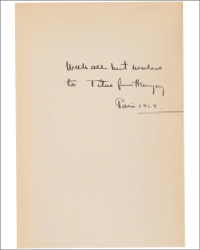
Bonhams, Dec. 8-18: Presentation Copy of Ernest Hemmingwayís A Farewell to Arms for Edward Titus of the Black Mankin Press. $30,000 - $50,000.
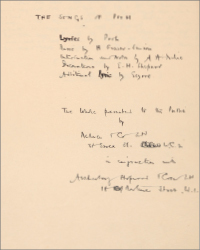
Bonhams, Dec. 8-18: Autograph Manuscript Signed Integrally for "The Songs of Pooh," by Alan Alexander. $30,000 - $50,000.
Bonhams, Dec. 8-18: Autograph Manuscript of "Three Fragments from Gˆtterd‰mmerung" by Richard Wagner. $30,000 - $50,000.
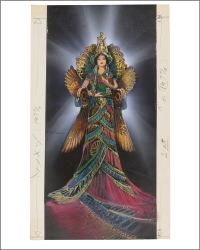
Bonhams, Dec. 8-18: Original Preliminary Artwork, for the First Edition of Snow Crash. $20,000 - $30,000.
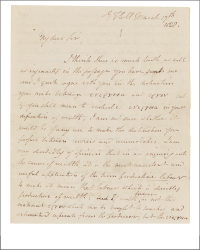
Bonhams, Dec. 8-18: Autograph Letter Signed ("T.R. Malthus") to Economist Nassau Senior on Wealth, Labor and Adam Smith. $20,000 - $30,000.
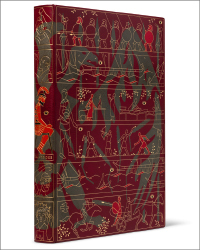
Bonhams, Dec. 8-18: History of the Peloponnesian War by Thucydides Finely Bound by Michael Wilcox. $20,000 - $30,000.
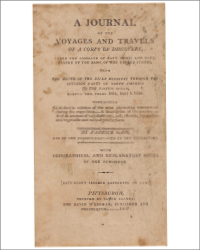
Bonhams, Dec. 8-18: First Edition of Lewis and Clark: Travels to the Source of the Missouri River and Across the American Continent to the Pacific Ocean. $8,000 - $12,000.
Bonhams, Dec. 8-18: Original Artwork for the First Edition of Neal Stephenson's Groundbreaking Novel Snow Crash. $100,000 - $150,000.
Bonhams, Dec. 8-18: A Complete Set Signed Deluxe Editions of King's The Dark Tower Series by Stephen King. $8,000 - $12,000.
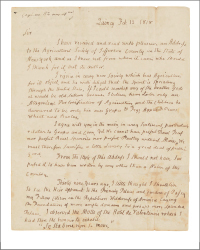
Bonhams, Dec. 8-18: Autograph Letter Signed ("John Adams") to James Le Ray de Chaumont During the Crucial Years of the Revolutionary War. $8,000 - $12,000.
Sotheby’s Book Week December 9-17, 2025
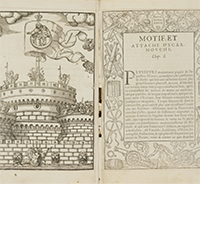
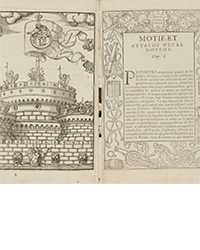
Sotheby’s, Dec. 17: Francesco Colonna. Hypnerotomachie, Paris, 1546, Parisian calf by Wotton Binder C for Marcus Fugger. €200,000 to €300,000.
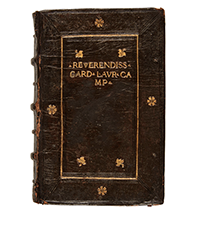
Sotheby’s, Dec. 17: Nausea. De principiis dialectices Gorgias, and other works, Venice, 1523, morocco gilt for Cardinal Campeggio. €3,000 to €4,000.
Sotheby’s, Dec. 17: Billon. Le fort inexpugnable de l'honneur, Paris, 1555, Parisian calf gilt for Peter Ernst, Graf von Mansfeld. €120,000 to €180,000.
Sotheby’s Book Week December 9-17, 2025
Sotheby’s, Dec. 16: Salinger, J.D. The Graham Family archive, including autographed letters, an inscribed Catcher, a rare studio photograph of the author, and more. $120,000 to $180,000.
Sotheby’s, Dec. 16: [Austen, Jane]. A handsome first edition of Sense and Sensibility, the author's first novel. $60,000 to $80,000.
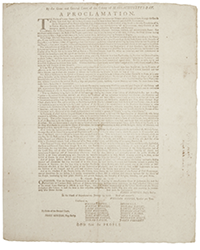
Sotheby’s, Dec. 16: Massachusetts General Court. A powerful precursor to the Declaration of Independence: "every Act of Government … without the Consent of the People, is … Tyranny." $40,000 to $60,000.
Heritage Auctions Rare Books Signature Auction December 15, 2025
Heritage, Dec. 15: John Donne. Poems, By J. D. With Elegies on the Author's Death. London: M[iles]. F[lesher]. for John Marriot, 1633.
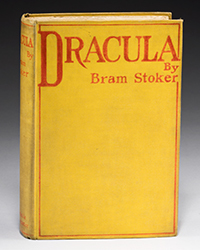
Heritage, Dec. 15: Edgar Rice Burroughs. Tarzan of the Apes.
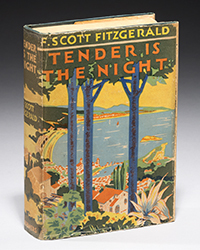
Heritage, Dec. 15: F. Scott Fitzgerald. Tender is the Night. A Romance.
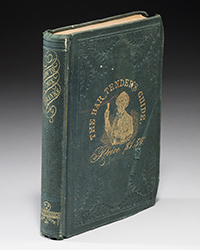
Heritage, Dec. 15: Jerry Thomas. How to Mix Drinks, or the Bon-Vivant's Companion, Containing Clear and Reliable Directions for Mixing All the Beverages Used in the United States…














![<b>Sotheby’s, Dec. 16:</b> [Austen, Jane]. A handsome first edition of <i>Sense and Sensibility,</i> the author's first novel. $60,000 to $80,000.](https://ae-files.s3.amazonaws.com/AdvertisementPhotos/9a74d9ff-42dd-46a1-8bb2-b636c4cec796.png "<b>Sotheby’s, Dec. 16:</b> [Austen, Jane]. A handsome first edition of <i>Sense and Sensibility,</i> the author's first novel. $60,000 to $80,000.")

![<b>Heritage, Dec. 15:</b> John Donne. <i>Poems, By J. D. With Elegies on the Author's Death.</i> London: M[iles]. F[lesher]. for John Marriot, 1633.](https://ae-files.s3.amazonaws.com/AdvertisementPhotos/8caddaea-4c1f-47a7-9455-62f53af36e3f.jpg "<b>Heritage, Dec. 15:</b> John Donne. <i>Poems, By J. D. With Elegies on the Author's Death.</i> London: M[iles]. F[lesher]. for John Marriot, 1633.")