Rare Book Monthly

Articles - October - 2025 Issue

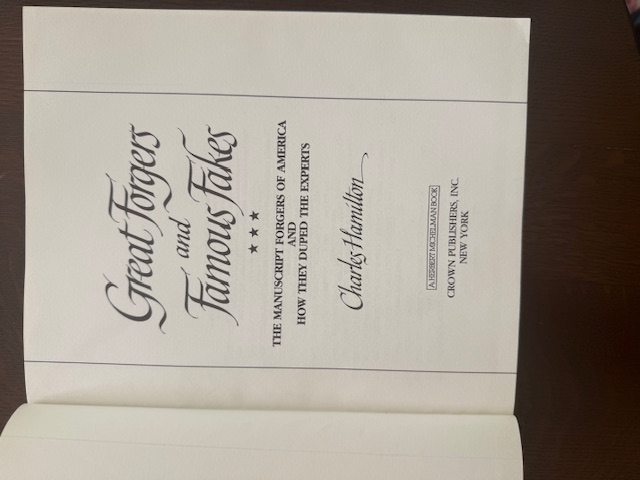
Great Forgers and Fabulous Fakes by Charles Hamilton. Printed in 1980.

Welcome to the fun house!!

Welcome to the fun house!!

Great Forgers and Fabulous Fakes by Charles Hamilton. Printed in 1980.

Advice that’s still fresh today.


Collecting paper has long been complicated. There’s a lot of it, many ways to approach it, and a lot of ways to buy it. And apparently there are many ways to fake it. Oh jeepers. Mr. Hamilton got quickly to the nib of the issue. Collectors love to have a physical personal connection to people they admire. The more you admire them, the more you want to have something tangible, and scoundrels noticed. Mr. Hamilton’s expertise was buying and selling such material and along the way learned to know the difference between authentic and unreal. Even serious collectors and collecting institutions have been susceptible to wishful thinking. The simple fact it’s fun to think a book, document or an envelope was in the master’s or mistress’s possession.


Forgers handling a mix of real and unreal manuscript material, have long attracted willing buyers. Once trust was established, the next step invariably was the collector or collecting institution to ask if the dealer/forger if they had anything else to consider.  “Why yes, let me sort through my holdings.”


Mr. Hamilton started his book by telling the stories of a dozen celebrated Lincoln forgers. Among them:


Joseph Cosey

Charles Weisberg

Henry Cleveland

Eugene Field, II

John Laffite (Lafflin)

Henry Woodhouse


They expressed their admiration of Abraham Lincoln in their unique way.


While Mr. Hamilton’s volume is launched with Lincoln stories, he would pluck the feathers from many turkeys over his 20 chapters.  He liked to understand the forger’s background, motivation and skill level.


I came across this book because one of our readers asked about material sold by or was associated with Eugene Field, II. It looked “good” to him, but others expressed doubt.


To answer his question, I spoke to two dealers about Eugene Field, II. Oh well, he was famous for his forgeries, mentioned in Hamilton’s book and I ordered it.  Many copies were available. Soon I was reading Great Forgers and Famous Fakes. Mr. Field turned out to be widely known and had his own chapter (pages 77-87).


This was all a bit of a surprise to me. Over the years I primarily bought from name dealers. It didn’t mean I was entirely immune to fakes or tricked up copies. I bought a few but they worked out. I was a naif.


Certainly, tricked up bindings and enhanced copies were whispered about over the years. Some websites have been impugned. eBay wasn’t perfect but I bought many nice things for reasonable prices over the years.


But now as I read Mr. Hamilton’s book, printed in 1980, I for the first time appreciate how widespread humdrum forgeries have been. I didn’t know.


I read Kenneth Rendell’s Safeguarding History: A Life with Paper in 2023. He solved complex crimes, many involving significant sums relating to forgery. At the time, I was grateful I avoided many of the pitfalls buyers of signed copies may encounter. I simply lucked out.


I built a small collection of Thomas J. Wise’s fakes 20 years ago. The goal was to buy his fakes. Nothing real, thank you. The prices were reasonable and out of the blue an esteemed ABAA dealer enquired whether he could buy the entire group. Of course! And he paid real money.


Since then, I have focused on interesting but essentially invisible material.  Forgeries are worth the trouble or the risk only when significant money is at stake. What I collect is satisfying but in the main, inexpensive.


All this taken together; Charles Hamilton’s book remains both entertaining and useful after these many years. If you are investing in signed material, you best know its history. Mr. Hamilton is long gone but Mr. Rendell is still active and has written 9 books on the subject.


There are many ways to collect paper.

Posted On: 2025-10-01 01:39
User Name: jwhalpern

Thanks for bringing renewed attention to Charles Hamilton's expertise on forgeries. In his later years, he brought out a revised edition of this book (1996), that is significantly expanded. An interesting aspect of the 1980 edition is that Mormon forger Mark Hofmann used it to devise the ink he used in his forgeries. Hamilton admitted (in the 1996 edition) to being fooled by some of Hofmann's forgeries.


Posted On: 2025-10-01 11:47
User Name: keeline

From 1980, it is older than the email summary states (45, not 40, years).

It has long been true that the more famous and desired the author, the more likely that someone will try to make a fake to prey upon the greed of the purchaser and forger. Consider the Ireland forgeries of Shakespeare.

For some works, the author is not in great demand and never was. Finding a signed copy of one of these creates a situation where it is perhaps the copy that sells first but is usually not more valuable.

Not included in this book but perhaps more commonly seen by book collectors, especially beginner- to intermediate-level collectors, is the act of taking a jacket from a later printing and putting it on a book that is a first printing to make a more valuable combination through a mismatch.

In the early 1990s a then well-known ABAA seller had Nancy Drew books from the 1930s (thick with internal illustrations) which had 1950s dust jackets put on them. Particularly when this is not properly identified, this is the basis for a fraud accusation.

A more subtle example is for a book like Tom Swift and His Giant Magnet (1932). It is the last book issued in the tan "quadrant" format. It was only available in that form from January to April 1932. However, the main sales for books of this type was in November and December for Christmas sales. By that time the tan cover stock was replaced by orange cloth with illustrated endpapers.

Some top collectors of the 1980s and 1990s, trying to make the best copies for themselves or for trade/resale would take a jacket from a more findable orange edition and put it on a found tan copy to make a more valuable combination.

But there are differences in the ads, the color of the inner surface listings, and even the colors of inks used on the cover illustration that show, to the informed, that it is an improper match.

Book buyers rely on booksellers to be the experts. It is not always a reasonable expectation. But this is why it is important to be informed and transparent, even if there are few real consequences for ignorance or wrongdoing in this area. Ethics is more than a code on a website, it is a practice.

James


Rare Book Monthly

  • Rare Book Hub is now mobile-friendly!
  • Swann
    Maps & Atlases, Natural History & Color Plate Books
    December 9, 2025
    Swann, Dec. 9: Lot 156: Cornelis de Jode, Americae pars Borealis, double-page engraved map of North America, Antwerp, 1593.
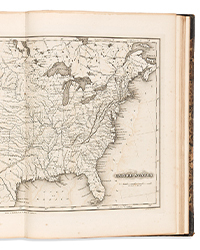
    Swann, Dec. 9: Lot 206: John and Alexander Walker, Map of the United States, London and Liverpool, 1827.
    Swann, Dec. 9: Lot 223: Abraham Ortelius, Typus Orbis Terrarum, hand-colored double-page engraved world map, Antwerp, 1575.
    Swann
    Maps & Atlases, Natural History & Color Plate Books
    December 9, 2025
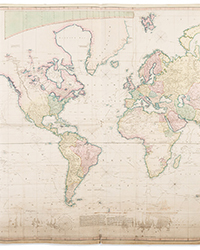
    Swann, Dec. 9: Lot 233: Aaron Arrowsmith, Chart of the World, oversize engraved map on 8 sheets, London, 1790 (circa 1800).
    Swann, Dec. 9: Lot 239: Fielding Lucas, A General Atlas, 81 engraved maps and diagrams, Baltimore, 1823.
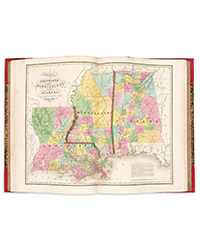
    Swann, Dec. 9: Lot 240: Anthony Finley, A New American Atlas, 15 maps engraved by james hamilton young on 14 double-page sheets, Philadelphia, 1826.
    Swann
    Maps & Atlases, Natural History & Color Plate Books
    December 9, 2025
    Swann, Dec. 9: Lot 263: John Bachmann, Panorama of the Seat of War, portfolio of 4 double-page chromolithographed panoramic maps, New York, 1861.
    Swann, Dec. 9: Lot 265: Sebastian Münster, Cosmographei, Basel: Sebastian Henricpetri, 1558.
    Swann, Dec. 9: Lot 271: Abraham Ortelius, Epitome Theatri Orteliani, Antwerp: Johann Baptist Vrients, 1601.
    Swann
    Maps & Atlases, Natural History & Color Plate Books
    December 9, 2025
    Swann, Dec. 9: Lot 283: Joris van Spilbergen, Speculum Orientalis Occidentalisque Indiae, Leiden: Nicolaus van Geelkercken for Jodocus Hondius, 1619.
    Swann, Dec. 9: Lot 285: Levinus Hulsius, Achtzehender Theil der Newen Welt, 14 engraved folding maps, Frankfurt: Johann Frederick Weiss, 1623.
    Swann, Dec. 9: Lot 341: John James Audubon, Carolina Parrot, Plate 26, London, 1827.
  • SD Scandinavian Art & Rare Book Auctions
    The Odfjell Collection
    Polar – History – Ornithology – Colour Plate Books
    Ending December 4th
    Scandinavian Art & Rare Books Auctions, Dec. 4: ROALD AMUNDSEN: «Sydpolen» [ The South Pole] 1912. First edition in jackets and publisher's slip case.
    Scandinavian Art & Rare Books Auctions, Dec. 4: AMUNDSEN & NANSEN: «Fram over Polhavet» [Farthest North] 1897. AMUNDSEN's COPY!
    Scandinavian Art & Rare Books Auctions, Dec. 4: ERNEST SHACKLETON [ed.]: «Aurora Australis» 1908. First edition. The NORWAY COPY.
    Scandinavian Art & Rare Books Auctions, Dec. 4: ERNEST SHACKLETON: «The heart of the Antarctic» + SUPPLEMENT «The Antarctic Book», 1909.
    Scandinavian Art & Rare Books Auctions, Dec. 4: SHACKLETON, BERNACCHI, CHERRY-GARRARD [ed.]: «The South Polar Times» I-III, 1902-1911.
    SD Scandinavian Art & Rare Book Auctions
    The Odfjell Collection
    Polar – History – Ornithology – Colour Plate Books
    Ending December 4th
    Scandinavian Art & Rare Books Auctions, Dec. 4: [WILLEM BARENTSZ & HENRY HUDSON] - SAEGHMAN: «Verhael van de vier eerste schip-vaerden […]», 1663.
    Scandinavian Art & Rare Books Auctions, Dec. 4: TERRA NOVA EXPEDITION | LIEUTENANT HENRY ROBERTSON BOWERS: «At the South Pole.», Gelatin Silver Print. [10¾ x 15in. (27.2 x 38.1cm.) ].
    Scandinavian Art & Rare Books Auctions, Dec. 4: ELEAZAR ALBIN: «A natural History of Birds.» + «A Supplement», 1738-40. Wonderful coloured plates.
    Scandinavian Art & Rare Books Auctions, Dec. 4: PAUL GAIMARD: «Voyage de la Commision scientific du Nord, en Scandinavie, […]», c. 1842-46. ONLY HAND COLOURED COPY KNOWN WITH TWO ORIGINAL PAINTINGS BY BIARD.
    Scandinavian Art & Rare Books Auctions, Dec. 4: JAMES JOYCE: «Ulysses», 1922. FIRST EDITION IN ORIGINAL WRAPPERS.
  • Sotheby’s
    Book Week
    December 9-17, 2025
    Sotheby’s, Dec. 11: Darwin and Wallace. On the Tendency of Species to form Varieties..., [in:] Journal of the Proceedings of the Linnean Society, Vol. III, No. 9., 1858, Darwin announces the theory of natural selection. £100,000 to £150,000.
    Sotheby’s, Dec. 11: J.K. Rowling. Harry Potter and the Philosopher's Stone, 1997, first edition, hardback issue, inscribed by the author pre-publication. £100,000 to £150,000.
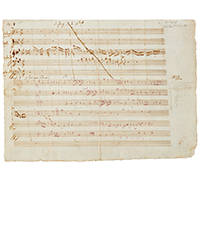
    Sotheby’s, Dec. 11: Wolfgang Amadeus Mozart. Autograph sketchleaf including a probable draft for the E flat Piano Quartet, K.493, 1786. £150,000 to £200,000.
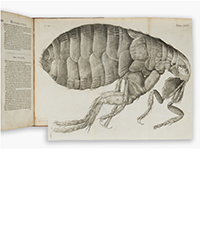
    Sotheby’s, Dec. 12: Hooke, Robert. Micrographia: or some Physiological Descriptions of Minute Bodies made by Magnifying Glasses. London: James Allestry for the Royal Society, 1667. $12,000 to $15,000.
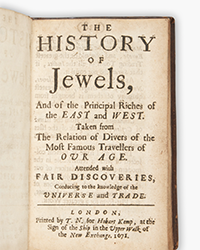
    Sotheby’s, Dec. 12: Chappuzeau, Samuel. The history of jewels, first edition in English. London: T.N. for Hobart Kemp, 1671. $12,000 to $18,000.
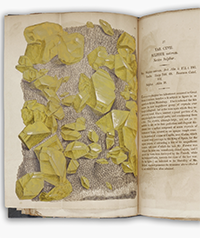
    Sotheby’s, Dec. 12: Sowerby, James. Exotic Mineralogy, containing his most realistic mineral depictions, London: Benjamin Meredith, 1811, Arding and Merrett, 1817. $5,000 to $7,000.

Article Search

Archived Articles