For the opening ceremony of the Olympic Games that took place last July in Paris, France offered a show that revealed her complex relationship with her past.
The opening ceremony of the Olympic Games in Paris took place last July. The ‘bouquinistes’ boxes were quietly aligned along the Seine River (a silent victory: https://www.rarebookhub.com/articles/3441 ) as the athletes sailed the river on ‘bateaux mouches’. Meanwhile, various shows were organized all around. Sometimes this ceremony reminded us of scenes from the Hunger Games movie: an abundance of forced bliss, colours, magnificent stages, loud music, and fireworks—and a slightly disturbing feeling of global debauchery, especially during the second part of the evening.
At one point, the French singer Philippe Katerine appeared on a huge dish plate, his almost naked body painted in blue, as the embodiment of Dionysus. Katerine is known for being a humorous and avant-gardiste artist but symbols matter, don’t they? And this was the symbol of the ‘pagan bacchanalia’ orchestrated by French director Thomas Jolly during the second part of the ceremony. Didn’t he re-enact the Last Supper in the background, with Jesus as an obese woman surrounded with transvestite apostles? No, he said, Da Vinci’s painting “wasn’t my inspiration.” All right, what was it, then? He wouldn’t say. His defenders claim it was another painting: Van Biljert’s Les Festins des dieux... which is clearly an iconoclast reinterpretation of Da Vinci’s Last Supper. The Katerine sequence was apparently censored in several parts of the world, including the States and some Middle-East countries.
The first part of the ceremony was ‘grandiose’. The second part was boring to me but interesting in the sense that it tended to depict France as a modern country that has broken up with her past—not only with religion and its prudishness, but also with centuries of royalty. As the obscure metal band Gojira started to perform, Marie Antoinette—once Queen of France—was shown holding her severed head in her hands—and the head was singing a revolutionary song: “Ca ira, ça ira, la aristocrates, faut les pendre.../ All will be fine, let’s hang the Aristocrats...” Following the 1789 Révolution, Marie Antoinette was beheaded in Paris in the wake of her husband Louis XVI (https://www.rarebookhub.com/articles/3613). The famous executioner Charles-Henri Sanson (https://www.rarebookhub.com/articles/2309/print?page_id=4354) then showed her head to the audience: Vive la république ! This scene was also very controverted and Jolly said: “It was an artistic representation, and certainly not the glorification of this death tool called the guillotine.” Of course, Gojira and Jolly weren’t calling for murder. It was, no doubt, a peace-and-love ceremony—well, except maybe for aristocrats.
The next day the ceremony was globally depicted as a success—the best opening ceremony ever, claimed several international newspapers. It nevertheless illustrates a French paradox. France’s past is a heavy heritage that we French people worship, and tend to despise at the same time—we’re actually struggling to assume it. We rely upon it to define ourselves as a great country (aaaah, le Château de Versailles!) but at the same time, we know we had to break up with it on several occasions. First and most was the Révolution of 1789—which has had such an impact on our identity that we’re still afraid we might not be worthy of it—, or the end of our dominion on various parts of the world. In the days of Louis XIV, we feared “ridicule”; today, we fear we might not be irreverent enough. This is the Robespierre’s complex—a radical revolutionary who sacrificed many to his vision (https://www.rarebookhub.com/articles/1124/print?page_id=2804 ). The second part of the ceremony looked like a spoilt child brutally playing with her heritage like she’d play with toys. On social media, the far left rejoiced. Shocking the conservatives is, they say, a Dionysian delight. Of course, words—or ceremonies—are cheap, as we all know. But lovers of old books know that they have consequences, and should be handled carefully. While the “révolutions de salon” (living room revolutions) take place on TV, the far right is gaining ground by the hour—let’s bear in mind that Robespierre was eventually beheaded too; by the same executioner who killed Marie-Antoinette.
T. Ehrengardt
![<b>Scandinavian Art & Rare Books Auctions, Dec. 4:</b> ROALD AMUNDSEN: «Sydpolen» [ The South Pole] 1912. First edition in jackets and publisher's slip case.](https://ae-files.s3.amazonaws.com/AdvertisementPhotos/0a99416d-9c0f-4fa3-afdd-7532ca8a2b2c.jpg "<b>Scandinavian Art & Rare Books Auctions, Dec. 4:</b> ROALD AMUNDSEN: «Sydpolen» [ The South Pole] 1912. First edition in jackets and publisher's slip case.")
![<b>Scandinavian Art & Rare Books Auctions, Dec. 4:</b> AMUNDSEN & NANSEN: «Fram over Polhavet» [Farthest North] 1897. AMUNDSEN's COPY!](https://ae-files.s3.amazonaws.com/AdvertisementPhotos/a077b4a5-0477-4c47-9847-0158cf045843.jpg "<b>Scandinavian Art & Rare Books Auctions, Dec. 4:</b> AMUNDSEN & NANSEN: «Fram over Polhavet» [Farthest North] 1897. AMUNDSEN's COPY!")
![<b>Scandinavian Art & Rare Books Auctions, Dec. 4:</b> ERNEST SHACKLETON [ed.]: «Aurora Australis» 1908. First edition. The NORWAY COPY.](https://ae-files.s3.amazonaws.com/AdvertisementPhotos/6363a735-e622-4d0a-852e-07cef58eccbe.jpg "<b>Scandinavian Art & Rare Books Auctions, Dec. 4:</b> ERNEST SHACKLETON [ed.]: «Aurora Australis» 1908. First edition. The NORWAY COPY.")
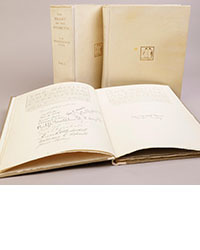
![<b>Scandinavian Art & Rare Books Auctions, Dec. 4:</b> SHACKLETON, BERNACCHI, CHERRY-GARRARD [ed.]: «The South Polar Times» I-III, 1902-1911.](https://ae-files.s3.amazonaws.com/AdvertisementPhotos/3ee16d5b-a2ec-4c03-aeb6-aa3fcfec3a5e.jpg "<b>Scandinavian Art & Rare Books Auctions, Dec. 4:</b> SHACKLETON, BERNACCHI, CHERRY-GARRARD [ed.]: «The South Polar Times» I-III, 1902-1911.")
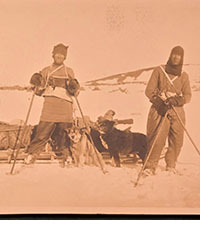
![<b>Scandinavian Art & Rare Books Auctions, Dec. 4:</b> [WILLEM BARENTSZ & HENRY HUDSON] - SAEGHMAN: «Verhael van de vier eerste schip-vaerden […]», 1663.](https://ae-files.s3.amazonaws.com/AdvertisementPhotos/d5f50485-7faa-423f-af0c-803b964dd2ba.jpg "<b>Scandinavian Art & Rare Books Auctions, Dec. 4:</b> [WILLEM BARENTSZ & HENRY HUDSON] - SAEGHMAN: «Verhael van de vier eerste schip-vaerden […]», 1663.")
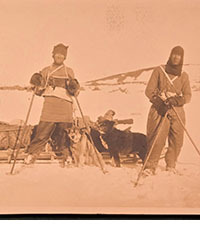
![<b>Scandinavian Art & Rare Books Auctions, Dec. 4:</b> TERRA NOVA EXPEDITION | LIEUTENANT HENRY ROBERTSON BOWERS: «At the South Pole.», Gelatin Silver Print. [10¾ x 15in. (27.2 x 38.1cm.) ].](https://ae-files.s3.amazonaws.com/AdvertisementPhotos/fb024365-7d7a-4510-9859-9d26b5c266cf.jpg "<b>Scandinavian Art & Rare Books Auctions, Dec. 4:</b> TERRA NOVA EXPEDITION | LIEUTENANT HENRY ROBERTSON BOWERS: «At the South Pole.», Gelatin Silver Print. [10¾ x 15in. (27.2 x 38.1cm.) ].")
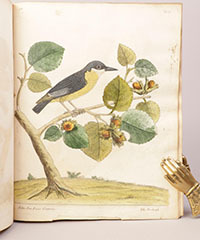
![<b>Scandinavian Art & Rare Books Auctions, Dec. 4:</b> PAUL GAIMARD: «Voyage de la Commision scientific du Nord, en Scandinavie, […]», c. 1842-46. ONLY HAND COLOURED COPY KNOWN WITH TWO ORIGINAL PAINTINGS BY BIARD.](https://ae-files.s3.amazonaws.com/AdvertisementPhotos/a7c0eda0-9d8b-43ac-a504-58923308d5a4.jpg "<b>Scandinavian Art & Rare Books Auctions, Dec. 4:</b> PAUL GAIMARD: «Voyage de la Commision scientific du Nord, en Scandinavie, […]», c. 1842-46. ONLY HAND COLOURED COPY KNOWN WITH TWO ORIGINAL PAINTINGS BY BIARD.")
![<b>Sotheby’s, Dec. 11:</b> Darwin and Wallace. On the Tendency of Species to form Varieties..., [in:] <i>Journal of the Proceedings of the Linnean Society,</i> Vol. III, No. 9., 1858, Darwin announces the theory of natural selection. £100,000 to £150,000.](https://ae-files.s3.amazonaws.com/AdvertisementPhotos/00d5fd41-2542-4a80-b119-4886d4b9925f.png "<b>Sotheby’s, Dec. 11:</b> Darwin and Wallace. On the Tendency of Species to form Varieties..., [in:] <i>Journal of the Proceedings of the Linnean Society,</i> Vol. III, No. 9., 1858, Darwin announces the theory of natural selection. £100,000 to £150,000.")