We think of “green” as meaning natural, healthy, life-giving like plants. Well, not always. Arsenic is the primary ingredient in something very green, a pigment known as Emerald Green or Paris Green. In its Emerald Green incarnation it is a vivid green pigment, a bright and attractive color used for coloring things such as wallpaper and paint. The latter includes paintings, with artists such as Renoir, Monet, Cezanne and Van Gogh having used it. It has also been used in book covers. In its incarnation as Paris Green it has a very different use, and this is the one most often associated with arsenic. It was used to kill pests. It has been sprayed on crops to kill insects and in other places to kill rodents. It got the name “Paris Green” because it was used to kill rats in Paris' sewers. As murder mystery readers know, it can also be used to kill humans.
The compound was invented in the early 19th century. As a pigment, its use was primarily confined to that century, but it continued to be used somewhat later to kill crop pests and mosquitoes. In books, it is mostly found on covers of mid-century books. If you have a 19th century book with a bright green cover, you may want to handle it cautiously and do some research to see if it is one that requires especially careful handling.
There is currently research on this subject being carried out at the Winterthur Museum and Library in Delaware. It is called the Poison Book Project. Their conservationists stumbled onto the issue a few years ago. Dr. Melissa Tedone was preparing books for a 2019 exhibit when she discovered that the bright green color easily came off in flakes. That led her to believe it was a pigment rather than a dye and she wondered if it if it might be the same Emerald Green used in wallpaper and other items in the 19th century. Stories abound about children becoming deathly ill in their rooms painted with this pigment in the 19th century.
Dr. Tedone brought the book to the Winterthur's Scientific Research and Analysis Lab where x-ray spectroscopy and various other tests were performed to determine the pigment's make-up. What they found was copper acetoarsenic, better known as Emerald Green.
From there they proceeded to undertake a more thorough investigation of old green books in their possession and that of the Philadelphia Library Company. In all they analyzed nearly 350 books and found 39 in Emerald Green colored bindings, some of which were in the circulating collection.
A similar case to this one, appropriate for an Agatha Christie mystery, came up in Denmark in 2018 when researchers also accidentally bumped into the issue. There was a book in the University of Southern Denmark's library and researchers were trying to discover what was written on parchment in the bindings. In the early days binders often used parts of old books to make their bindings. They couldn't get a good look with x-rays as a wall of green paint was in the way. When they examined it further, they discovered that the paint was the arsenic-laden Emerald Green. However, in this case the pigment wasn't being used to create bright green covers as it was buried under the covers. The Danish researchers concluded that most likely it was there for its other use, to keep bookworms and other insects from devouring the book. You can look back at that story by clicking here.
The researchers and conservationists at the Winterthur have taken their knowledge one step further. They have initiated the Poison Book Project. Along with the 39 of 350 containing arsenic they found 50% contained lead in the bookcloth, others chromium. Still, it is the arsenic that is the major concern. They are now focusing on green bookcloth as that is where arsenic is found. They concluded, “Emerald green publishers’ bindings present a health risk to librarians, booksellers, collectors, and researchers, and should be identified, handled, and stored with caution.” They recommend using the disposable nitrile gloves used in the medical profession when handling them. They suggest these books be stored in zip-top polyethylene bags. Extra care is needed as what Ms. Tedone initially noticed is the case – the green pigment readily peels off.
If you think you may have one of these arsenic books, they are providing color swatches to help identify the color (they are arsenic-free). You can receive one by contacting them by email at reference@winterthur.org. Provide your name and postal address. They have also created a database of books that may have arsenic in the covers. They have identified 101 so far. All are from the 19th century with the great majority from the middle of that century. You can find the Arsenical Books Database at the following link: wiki.winterthur.org/wiki/ARSENICAL_BOOKS_DATABASE.
We don't mean to alarm you and as long as you don't lick or eat your book covers you won't die. But be forewarned, if you aren't careful, don't wash your hands or protect cuts and open sores, or you breathe in too much of the dust, you could get fairly sick.
![<b>Scandinavian Art & Rare Books Auctions, Dec. 4:</b> ROALD AMUNDSEN: «Sydpolen» [ The South Pole] 1912. First edition in jackets and publisher's slip case.](https://ae-files.s3.amazonaws.com/AdvertisementPhotos/0a99416d-9c0f-4fa3-afdd-7532ca8a2b2c.jpg "<b>Scandinavian Art & Rare Books Auctions, Dec. 4:</b> ROALD AMUNDSEN: «Sydpolen» [ The South Pole] 1912. First edition in jackets and publisher's slip case.")
![<b>Scandinavian Art & Rare Books Auctions, Dec. 4:</b> AMUNDSEN & NANSEN: «Fram over Polhavet» [Farthest North] 1897. AMUNDSEN's COPY!](https://ae-files.s3.amazonaws.com/AdvertisementPhotos/a077b4a5-0477-4c47-9847-0158cf045843.jpg "<b>Scandinavian Art & Rare Books Auctions, Dec. 4:</b> AMUNDSEN & NANSEN: «Fram over Polhavet» [Farthest North] 1897. AMUNDSEN's COPY!")
![<b>Scandinavian Art & Rare Books Auctions, Dec. 4:</b> ERNEST SHACKLETON [ed.]: «Aurora Australis» 1908. First edition. The NORWAY COPY.](https://ae-files.s3.amazonaws.com/AdvertisementPhotos/6363a735-e622-4d0a-852e-07cef58eccbe.jpg "<b>Scandinavian Art & Rare Books Auctions, Dec. 4:</b> ERNEST SHACKLETON [ed.]: «Aurora Australis» 1908. First edition. The NORWAY COPY.")
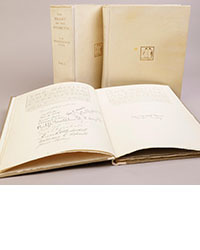
![<b>Scandinavian Art & Rare Books Auctions, Dec. 4:</b> SHACKLETON, BERNACCHI, CHERRY-GARRARD [ed.]: «The South Polar Times» I-III, 1902-1911.](https://ae-files.s3.amazonaws.com/AdvertisementPhotos/3ee16d5b-a2ec-4c03-aeb6-aa3fcfec3a5e.jpg "<b>Scandinavian Art & Rare Books Auctions, Dec. 4:</b> SHACKLETON, BERNACCHI, CHERRY-GARRARD [ed.]: «The South Polar Times» I-III, 1902-1911.")
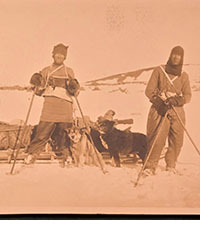
![<b>Scandinavian Art & Rare Books Auctions, Dec. 4:</b> [WILLEM BARENTSZ & HENRY HUDSON] - SAEGHMAN: «Verhael van de vier eerste schip-vaerden […]», 1663.](https://ae-files.s3.amazonaws.com/AdvertisementPhotos/d5f50485-7faa-423f-af0c-803b964dd2ba.jpg "<b>Scandinavian Art & Rare Books Auctions, Dec. 4:</b> [WILLEM BARENTSZ & HENRY HUDSON] - SAEGHMAN: «Verhael van de vier eerste schip-vaerden […]», 1663.")
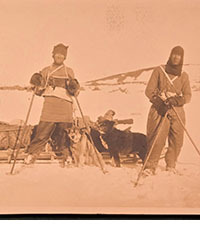
![<b>Scandinavian Art & Rare Books Auctions, Dec. 4:</b> TERRA NOVA EXPEDITION | LIEUTENANT HENRY ROBERTSON BOWERS: «At the South Pole.», Gelatin Silver Print. [10¾ x 15in. (27.2 x 38.1cm.) ].](https://ae-files.s3.amazonaws.com/AdvertisementPhotos/fb024365-7d7a-4510-9859-9d26b5c266cf.jpg "<b>Scandinavian Art & Rare Books Auctions, Dec. 4:</b> TERRA NOVA EXPEDITION | LIEUTENANT HENRY ROBERTSON BOWERS: «At the South Pole.», Gelatin Silver Print. [10¾ x 15in. (27.2 x 38.1cm.) ].")
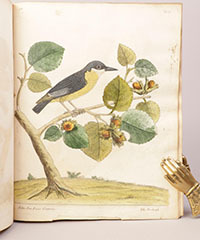
![<b>Scandinavian Art & Rare Books Auctions, Dec. 4:</b> PAUL GAIMARD: «Voyage de la Commision scientific du Nord, en Scandinavie, […]», c. 1842-46. ONLY HAND COLOURED COPY KNOWN WITH TWO ORIGINAL PAINTINGS BY BIARD.](https://ae-files.s3.amazonaws.com/AdvertisementPhotos/a7c0eda0-9d8b-43ac-a504-58923308d5a4.jpg "<b>Scandinavian Art & Rare Books Auctions, Dec. 4:</b> PAUL GAIMARD: «Voyage de la Commision scientific du Nord, en Scandinavie, […]», c. 1842-46. ONLY HAND COLOURED COPY KNOWN WITH TWO ORIGINAL PAINTINGS BY BIARD.")
![<b>Sotheby’s, Dec. 11:</b> Darwin and Wallace. On the Tendency of Species to form Varieties..., [in:] <i>Journal of the Proceedings of the Linnean Society,</i> Vol. III, No. 9., 1858, Darwin announces the theory of natural selection. £100,000 to £150,000.](https://ae-files.s3.amazonaws.com/AdvertisementPhotos/00d5fd41-2542-4a80-b119-4886d4b9925f.png "<b>Sotheby’s, Dec. 11:</b> Darwin and Wallace. On the Tendency of Species to form Varieties..., [in:] <i>Journal of the Proceedings of the Linnean Society,</i> Vol. III, No. 9., 1858, Darwin announces the theory of natural selection. £100,000 to £150,000.")