Rare Book Monthly
Articles - December - 2002 Issue
Where It All Began - A Visit to the American Antiquarian Society
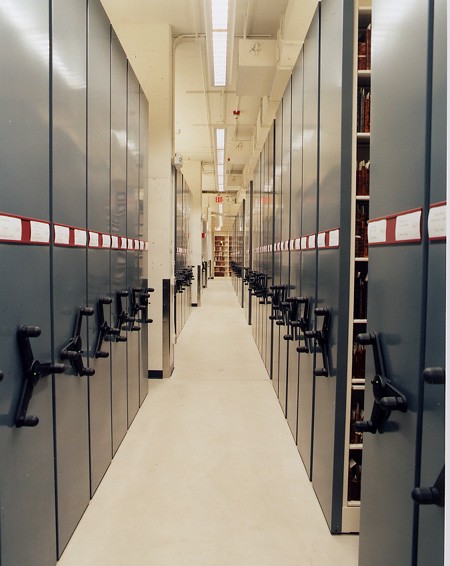
Rolling shelves hold great volumes of material in a compact space. Photo courtesy of AAS.
Many of the books and papers written by the fellows are now part of the collections. That brings us to a side point. Not only does the Society hold an enormous amount of the pre-1877 material in existence, it also possesses many works about the material of this era. Newer books about the subjects of the AAS’ collections are also held at Antiquarian Hall. This includes 3,250 volumes of bibliographic material available in the Hall’s reading room.
The Society also sponsors numerous other educational programs. It publishes books, offers lectures and seminars, and even has a program geared toward area schools. An actor recreates the personage of founder Isaiah Thomas and visits schools to tell his story and that of the founding of the nation.
Asked about the AAS’ mission, Ms. Dunlap speaks of two, preserving the nation’s early printed history, and making it available for research. However, as important as the research is, there’s no question that the first mission is preservation. This is why the AAS is focused on having originals of everything, not electronic or photo copies. “The AAS will always retain the physical connection,” she says. “People give us material that has been scanned elsewhere. Others don’t need to have the originals. This is our role. In a world where everyone has seen a copy, one place should have the originals.”
She goes on to say “What amazes me is it was all thought up by one person. We do exactly what Isaiah Thomas told us in 1812 and for the same reason. It’s his passion for collecting one piece of everything that was available. He saw the nation created by the power of the press. He felt it was his obligation to preserve this. I find that very inspiring.”
To understand the “passion for collecting one piece of everything,” you need to see each piece as part of a puzzle, rather than stand alone documents, as amazing as many of the individual pieces are. For example, the ledgers of an individual business are not very exciting by themselves, but if you have them from many businesses, spread over a range of time, you can see business evolve and grow. That’s where you begin to see a picture of how America grew during her early years. As Ellen Dunlap explains, “What surprised me most is not ‘oh my God, look at this book.’ Here it’s the comprehensive nature that we have everything. Individual items are not necessarily interesting, but the entire collection gives you the picture of how everything interacts.” And this is what makes Antiquarian Hall such an extraordinary place for research. You can truly follow the evolution of any aspect of America’s early history because, more than anywhere else, the AAS comes closest to having everything.
So why do the collections stop with 1876? Ms. Dunlap cites several reasons for this cut off. The primary reason is that the AAS’ mission is to be comprehensive in what it collects, but this requires setting some limits. Otherwise, the project becomes unmanageable. 1876 was selected as it marks the end of a significant era, Reconstruction, and also is the nation’s centennial. Additionally, it’s the time where the U.S. copyright office begins requiring that copies of all books be sent there, giving the government the opportunity to amass the best collection of all U.S. publications going forward, and at no cost. Finally, Ms. Dunlap noted that printing takes off astronomically in this era, making comprehensive collecting of printed Americana an overwhelming task for a private institution like the Society. However, in some areas, like Alaska, or even the West in general, the AAS collections do continue to a later date because there was very little material printed before 1877. And, as noted before, the AAS does collect later printed material about the earlier items that form the basis of their collections.
![<b>Sotheby’s, Dec. 11:</b> Darwin and Wallace. On the Tendency of Species to form Varieties..., [in:] <i>Journal of the Proceedings of the Linnean Society,</i> Vol. III, No. 9., 1858, Darwin announces the theory of natural selection. £100,000 to £150,000.](https://ae-files.s3.amazonaws.com/AdvertisementPhotos/00d5fd41-2542-4a80-b119-4886d4b9925f.png "<b>Sotheby’s, Dec. 11:</b> Darwin and Wallace. On the Tendency of Species to form Varieties..., [in:] <i>Journal of the Proceedings of the Linnean Society,</i> Vol. III, No. 9., 1858, Darwin announces the theory of natural selection. £100,000 to £150,000.")