Rare Book Monthly

Articles - April - 2017 Issue

A Study of Old Book Smell Is Being Conducted at the Morgan Library

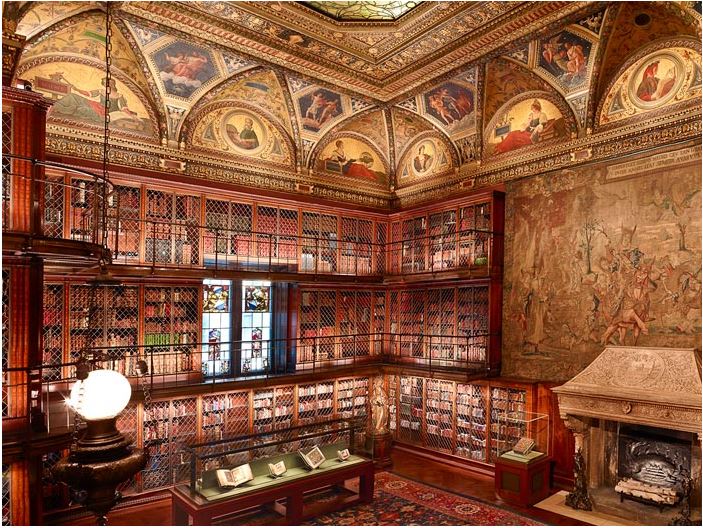
Pierpont Morgan's personal library (from the Morgan Library website).

Pierpont Morgan's personal library (from the Morgan Library website).

An unusual study of old books and smells is taking place at the Morgan Library in New York, combining the library, students from the Columbia Graduate School of Architecture Planning and Preservation, and the company International Flavors and Fragrances. The students are placing a clear, bell-shaped device, with sensors at the top and an air hose running to the side, on top of old books and whatever else they want to sample. The samples are then taken to IFF where they will be analyzed in the months ahead.


They aren't sampling just any old books, or any location in the building. The work is being done in the personal library of J. Pierpont Morgan, the turn of the century extraordinarily wealthy banker, industrialist and philanthropist, who used some of that wealth to collect rare books. He left his library to the public when he died. That was over a century ago, but his personal library hasn't changed all that much since he left.


This study was recently reported in the art blog Hyperalleric with a follow-up from the New York Times. I must admit that after reading both articles, I'm not quite sure why they are doing this. It is certainly an esoteric study. The Times came closest to understanding the intent, noting that maybe it could be used to recreate the smells of the old library for an exhibit, to "experience the library in a different way." They quoted Christine Nelson, a curator at the library, with the mystical explanation, "When we started this, we didn’t really know where this would go, and we still don’t, quite; it’s still an experiment." Whatever the purpose, the smell of old books is distinctive and a magnet to book collectors. It is not a pleasant aroma on its own, but an associative one, like "new car" smell, mainly a byproduct of glue, vinyl, plastics, and lubricants, people love only because they associate it with new cars.


We should note that this is not the first study done on the smell of old books. A study was conducted and posted to Analytical Chemistry in 2009 entitled Material Degradomics: On the Smell of Old Books. This one had more of a specific purpose – to help conservators preserve the old books under their care. Different books give off different odors depending on their paper and other elements of composition. These differences may not be easily recognizable to humans, who probably lump them all together as being the smell of old books. However, when instruments designed to calculate the chemical compositions of the VOC's (volatile organic compounds) are used to determine their precise make up, the composition of each book can be determined. This, in turn, allows conservators to determine the best course of action to preserve each particular book based on its precise composition.


The authors of the study, Matija Strlic, Jacob Thomas, Tanja Trafela, Linda Cséfalvayova´, Irena Kralj Cigic´, Jana Kolar, and May Cassar, described the smell as, "a combination of grassy notes with a tang of acids and a hint of vanilla over an underlying mustiness." This sounds like wine-tasters language. The most important compounds and factors, they determined, are rosin, lignin and carbonyl group content, degree of polymerization of cellulose, and paper acidity. Around 1850, rosin replaced gelatin to make ink adhere to the paper. Aluminum sulfate was used to get the rosin to precipitate to the fibers. Aluminum sulfate is acidic, explaining the more rapid deterioration of paper common to post-1850 books.


For chemists seeking more detail about the literally hundreds of volatile and semi-volatile gasses given off by the old books, those most commonly found were acetic acid, benzaldehyde, 2,3-butanedione, butanol, decanal, 2,3-dihydrofuran, 2-ethylhexanol, furfural, hexadecane, hexanal, methoxyphenyloxime, nonanal, octanal, pentanal, and undecane.
Rare Book Monthly

  • Heritage Auctions
    Rare Books Signature Auction
    December 15, 2025
    Heritage, Dec. 15: John Donne. Poems, By J. D. With Elegies on the Author's Death. London: M[iles]. F[lesher]. for John Marriot, 1633.
    Heritage, Dec. 15: Edgar Rice Burroughs. Tarzan of the Apes.
    Heritage, Dec. 15: F. Scott Fitzgerald. Tender is the Night. A Romance.
    Heritage, Dec. 15: Bram Stoker. Dracula. Westminster: Archibald Constable & Co., 1897.
    Heritage, Dec. 15: Jerry Thomas. How to Mix Drinks, or the Bon-Vivant's Companion, Containing Clear and Reliable Directions for Mixing All the Beverages Used in the United States…
  • Rare Book Hub is now mobile-friendly!
  • Bonhams, Dec. 8-18: Autograph Letter Signed ("Martinus Luther") to His Friend the Theologian Gerhard Wiskamp ("Gerardo Xantho Lampadario"). $100,000 - $150,000.
    Bonhams, Dec. 8-18: An Exceptionally Fine Copy of Austenís Emma: A Novel in Three Volumes. $40,000 - $60,000.
    Bonhams, Dec. 8-18: Presentation Copy of Ernest Hemmingwayís A Farewell to Arms for Edward Titus of the Black Mankin Press. $30,000 - $50,000.
    Bonhams, Dec. 8-18: Autograph Manuscript Signed Integrally for "The Songs of Pooh," by Alan Alexander. $30,000 - $50,000.
    Bonhams, Dec. 8-18: Autograph Manuscript of "Three Fragments from Gˆtterd‰mmerung" by Richard Wagner. $30,000 - $50,000.
    Bonhams, Dec. 8-18: Original Preliminary Artwork, for the First Edition of Snow Crash. $20,000 - $30,000.
    Bonhams, Dec. 8-18: Autograph Letter Signed ("T.R. Malthus") to Economist Nassau Senior on Wealth, Labor and Adam Smith. $20,000 - $30,000.
    Bonhams, Dec. 8-18: History of the Peloponnesian War by Thucydides Finely Bound by Michael Wilcox. $20,000 - $30,000.
    Bonhams, Dec. 8-18: First Edition of Lewis and Clark: Travels to the Source of the Missouri River and Across the American Continent to the Pacific Ocean. $8,000 - $12,000.
    Bonhams, Dec. 8-18: Original Artwork for the First Edition of Neal Stephenson's Groundbreaking Novel Snow Crash. $100,000 - $150,000.
    Bonhams, Dec. 8-18: A Complete Set Signed Deluxe Editions of King's The Dark Tower Series by Stephen King. $8,000 - $12,000.
    Bonhams, Dec. 8-18: Autograph Letter Signed ("John Adams") to James Le Ray de Chaumont During the Crucial Years of the Revolutionary War. $8,000 - $12,000.
  • Sotheby’s
    Book Week
    December 9-17, 2025
    Sotheby’s, Dec. 11: Darwin and Wallace. On the Tendency of Species to form Varieties..., [in:] Journal of the Proceedings of the Linnean Society, Vol. III, No. 9., 1858, Darwin announces the theory of natural selection. £100,000 to £150,000.
    Sotheby’s, Dec. 11: J.K. Rowling. Harry Potter and the Philosopher's Stone, 1997, first edition, hardback issue, inscribed by the author pre-publication. £100,000 to £150,000.
    Sotheby’s, Dec. 11: Wolfgang Amadeus Mozart. Autograph sketchleaf including a probable draft for the E flat Piano Quartet, K.493, 1786. £150,000 to £200,000.
    Sotheby’s, Dec. 12: Hooke, Robert. Micrographia: or some Physiological Descriptions of Minute Bodies made by Magnifying Glasses. London: James Allestry for the Royal Society, 1667. $12,000 to $15,000.
    Sotheby’s, Dec. 12: Chappuzeau, Samuel. The history of jewels, first edition in English. London: T.N. for Hobart Kemp, 1671. $12,000 to $18,000.
    Sotheby’s, Dec. 12: Sowerby, James. Exotic Mineralogy, containing his most realistic mineral depictions, London: Benjamin Meredith, 1811, Arding and Merrett, 1817. $5,000 to $7,000.

Article Search

Archived Articles