Texas and the American West from Kenston Rare Books
- by Michael Stillman
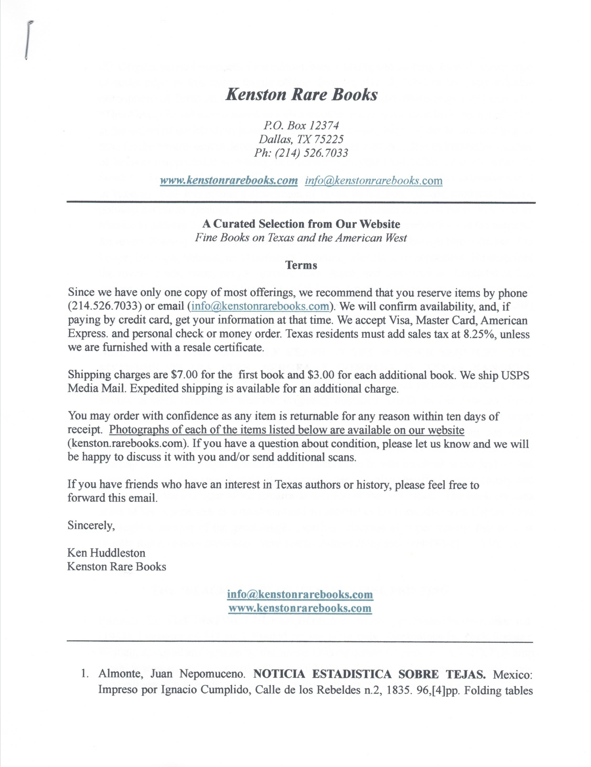
Texas and the American West from Kenston Rare Books
Kenston Rare Books is offering a curated selection of Fine Books on Texas and the American West. Kenston is the book selling business of Ken Huddleston, a native Texan and collector. The Lone Star State is their prime focus, and if you have any doubt that Texas is the center of the universe, just ask any Texan. So, here are some books about Texans and a few other people who wish they were Texans.
We begin with one of the earliest post-Revolutionary accounts of Texas, History of the Revolution in Texas, Particularly of the War of 1826 & '36; Together with the Latest Geographical, Topographical and Statistical Accounts of the Country, from the Most Authentic Sources. The author was Rev. Chester Newell, the publication date 1838. Quoting Jenkins, “This is one of the earliest books published about Texas after it became a republic. The work begins with an excellent summary of Mexican history from 1821 to 1835, followed by a sketch of Texas history from 1832 to 1835...” It also describes events of 1836 and Santa Anna's capture. Newell quotes from participating Texans and Mexican sources, such as Almonte's diary. The other part of the book describes the towns, projects the future, and analyzes the people of Texas. Newell spoke with many of the participants in the revolution such as Houston and Lamar. Item 28. Priced at $3,850.
Speaking of Almonte, here is Juan Almonte's 1835 account of his 1834 visit to Texas. The title is Noticia Estadistica Sobre Tejas (statistical news about Texas). He was sent there by the Mexican government. His account provides the best understanding available of Texas on then eve of its revolution. His trip took him to several communities in Texas, including Harrisburg (now known as Houston). He describes the geography, natural history, Indian tribes (friendly and hostile), the history of slavery and the Indians, and population density. Almonte was sent to placate the Texans who were becoming more agitated and starting to present a threat to the Mexican government. Almonte is somewhat sympathetic to them. Most importantly, he provided data as to the settlers military strength in case they rebelled. In an aside, a century-old description of Almonte's book from Maggs displays the sentiments of European settlers of America that allowed them to be so contemptuous of others, “The statistics of Almonte form the proudest testimonial to the labours of those fearless and persevering spirits who first rendered the golden glebe of Texas tributary to the enjoyments of civilised man, and supply a conclusive answer to the charges brought against the Texans by persons, who, in the fervour of a philanthropic enthusiasm on behalf of the Indian and Negro, are ready to sacrifice not only time and money, but the solemn obligations of truth and justice.” Take that, wokeism. Item 1. $18,500.
As long as we are hearing about revolutionary Texas from a point of view seldom heard, here is a 1955 printing of a previously unpublished manuscript account of the Battle of the Alamo from a Mexican officer, La Rebelion de Texas; Manuscrito Inedito de 1836 Por Un Oficial de Santa Anna…(The Rebellion of Texas, 1836, Unpublished Manuscript By An Officer of Santa Anna…). That officer was Jose Enrique de la Pena. This is the first edition. Jenkins, writing from the second edition, says, “Written by an intelligent and perceptive Mexican staff officer, this is one of the most important eye-witness records of the Texas Revolution, and especially of the Siege of the Alamo. Llerena Friend called it: ‘the detailed story by a participant observer who had military training and who also was well read, observant of the natural scene and of human character and passionately devoted to his country…” Translator Carmen Perry commented that de la Pena's account is, “significant because he was an active participant, an eyewitness and a trained officer, who had advantages in observation and evaluation coupled with honest objectivity.” Naturally, this account is from the Mexican perspective, but it is the most accurate available since none of the Texans survived to give their point of view. One claim de la Pena made that became extremely controversial as it differs from legend accepted by Texans is that Davy Crockett and others did not die hopelessly defending the Alamo to the last man, but that they surrendered. Santa Anna executed them. Either way, they did the best they possibly could. De la Pena also provides an account of the the Mexicans' retreat from Texas after the war turned against them. Item 4. $1,150.
This is the story of a bank robber from the days when they were some of America's greatest celebrities, the 1920s-1930s. Harvey Bailey was no celebrity, at least not until his career came to an end. His account of his business career is Robbing Banks Was My Business. The Story of J. Harvey Bailey, America's Most Successful Bank Robber. The author was western writer J. Evetts Haley, publication date 1973. He knew some of the most famous bandits of his era, Capone, Machine Gun Kelly, Pretty Boy Floyd and Alvin Karpis, among others. He partnered with Floyd and Karpis in some of his bank heists. Despite his business, his success, and his associates, Bailey flew under the radar. He liked it that way. For over a decade he robbed banks and no one, even law enforcement, ever heard of him. Bailey looked more like a banker than a bank robber. He started in North Dakota and stuck to banks in out of the way places where police were not the most accomplished. They assumed his robberies were the work of one of the celebrity robbers. During the years 1920-1932, he may well have lived up to the description as the “most successful bank robber,” but it all came crashing down when he was caught in 1932. Authorities traced him back to many of his previous robberies. Bailey was finally a celebrity, but it didn't last as he has since again faded into obscurity. He escaped prison but was recaptured in 1933. His escape was an unfortunate mistake as while he was out, he was in the wrong place at the wrong time and was convicted as an accomplice in a kidnapping in which he was probably not involved. He was sentenced to life, paroled in 1964 at age 76, got a job making furniture, and lived to 91. Haley spent a good amount of time interviewing and traveling with Bailey to write this book. Item 18. $900.
Next is a 12-panel accordion promotional brochure for Las Vegas. No, not that Las Vegas. It is a Souvenir of Las Vegas New Mexico, the Leading City of the Territory. It was published for use at the Chicago Columbian Exposition in 1893. It was a resort town, but the brochure also promotes the city for business and a place to settle. In 1893, Las Vegas, New Mexico, was the biggest Las Vegas. It had a population around 2,500 while the one in Nevada did not yet even exist. Item 21. $375.
You may reach Kenston Rare Books at 214-526-7033 or info@kenstonrarebooks.com. Their website is www.kenstonrarebooks.com.